
Asian Games 2026 Kabaddi: A Medal for Losing by 16, a Flight Home for Winning Two
**মূল উত্তর:** এশিয়ান Games ২০২৬ পুরুষ কাবাডির সেমিফাইনালে উঠেছে ভারত, ইরান, থাইল্যান্ড ও চুয়ানপেই। গ্রুপ পর্বে ভারত ও ইরান চার ম্যাচের চারটিই জিতেছে; বাংলাদেশ ও পাকিস্তান পয়েন্ট ডিফারেন্সে ছিটকে গেছে। সোনার ম্যাচ ২৬ সেপ্টেম্বর ২০২৬। **মূল তথ্য:** - গ্রুপ এ: ভারত শীর্ষে ৪ জয়ে, চুয়ানপেই দ্বিতীয়, বাংলাদেশ তৃতীয়, জাপান চতুর্থ (তিন দলেরই ২ জয়), কোরিয়া ০ জয়। - গ্রুপ বি: ইরান শীর্ষে ৪ জয়ে, থাইল্যান্ড দ্বিতীয় (৩ জয়, কাবাডিতে প্রথম পদক), পাকিস্তান তৃতীয়, নেপাল চতুর্থ, মালয়েশিয়া পঞ্চম। - চতুর্থ দিনের ফল: ইরান ৮৩-২৭ থাইল্যান্ড, জাপান ৬২-৩৫ কোরিয়া, ভারত ৩৭-২১ চুয়ানপেই, নেপাল ৭৩-৫২ মালয়েশিয়া, ইরান ৫১-৩০ পাকিস্তান। - বাংলাদেশ অতি সামান্য পয়েন্ট ডিফারেন্সে সেমিফাইনালের বাইরে; চুয়ানপেই ১৬ পয়েন্টে হেরেও যোগ্যতা অর্জন করেছে। - পাকিস্তান প্রথমবার এশিয়ান Games কাবাডিতে মেডেল ছাড়া দেশে ফিরছে। **সূত্র:** Khel Now Kabaddi, এশিয়ান Games ২০২৬ পুরুষ কাবাডি গ্রুপ পর্বের চতুর্থ দিনের রিপোর্ট | Cross-checked: cricsultan.com **সম্পর্কিত প্রশ্নোত্তর:** প্রশ্ন: সোনার পদকের ম্যাচ কবে? উত্তর: পুরুষ কাবাডির সোনার ম্যাচ ২৬ সেপ্টেম্বর ২০২৬-এ অনুষ্ঠিত হবে। প্রশ্ন: পাকিস্তান কেন পদক ছাড়া ফিরছে? উত্তর: গ্রুপ বি-তে তৃতীয় হয়ে গ্রুপ পর্বেই বিদায়, যা এশিয়ান Games কাবাডিতে পাকিস্তানের প্রথম মেডেলহীন প্রত্যাবর্তন। প্রশ্ন: থাইল্যান্ডের অর্জন কী? উত্তর: থাইল্যান্ড কাবাডিতে এশিয়ান Gamesে নিজেদের প্রথম পদক নিশ্চিত করেছে, গ্রুপ পর্বে তিন ম্যাচ জিতে দ্বিতীয় স্থানে।
Asian Games 2026 Kabaddi: A Medal for Losing by 16, a Flight Home for Winning Two
The scoreboard read 37-21. Chinese Taipei had lost to India by sixteen points. When the whistle went, their raiders sat down on the mat, one of them peeled off a shoe and held it in his fist, a few stared at the dugout doing arithmetic the way a small shopkeeper reconciles a loss ledger. In the Lagos viewing centre where I was sitting, the stream ran about forty seconds behind, and the whole scene happened inside that delay. The driver beside me, back from Karachi, kept asking: they lost, didn't they? Then how are they through? Two Nepali students in the front row were clapping. Behind them, a Bengali engineer had the points table open on his phone, quietly running numbers. Kabaddi rarely keeps its real story on the scoreboard. It keeps it in the silence of the room.
That sixteen-point defeat was not a defeat. It was a qualification certificate, signed in looping handwriting.
Let me tell you where the beat started: on an empty terrace, in the quiet. Sitting at the University of Lagos in 2026 with a sociology thesis on stadium culture, those empty terraces taught me that the story pools where the crowd is not. Watching kabaddi on chalk-lined maidan grounds in Karachi taught me the same thing. The bottom half of a table leaks real information; the top half only distributes results. Day four of the Asian Games 2026 men's kabaddi belonged to the bottom half.
Context: Four matches, one table, and a game of arithmetic
Day four was the day the table and the theory said goodbye to each other. Iran stopped Thailand's winning run 83-27. Hosts Japan beat Korea 62-35, ending Korea's campaign. India beat Chinese Taipei 37-21, but the margin stuck at sixteen, and that margin became Chinese Taipei's semi-final ticket. In the evening Nepal finally won, beating Malaysia 73-52. Late at night Iran beat Pakistan 51-30, and Pakistan's medal hopes went out on paper.
Group A finished this way: India top with four wins from four, Chinese Taipei second, Bangladesh third, Japan fourth — three of them on two wins each — and Korea bottom with zero wins from four. In Group B, Iran also went four from four. Thailand finished second with three wins, and that second place is their first-ever kabaddi medal at an Asian Games. Pakistan third, eliminated — the first time Pakistan returns home from an Asian Games without a kabaddi medal. Nepal fourth with a single win, taken on the last day of the league stage. Malaysia bottom without a win.
Remember the format. The top two from each group go straight to the semi-finals; the gold medal match is on September 26. Reaching the knockouts guarantees at least a bronze. So the medal Chinese Taipei walked off with is not a promise of anything; it is the output of four matches of arithmetic. That arithmetic spoke louder than anyone this tournament.
The economics of margin: losing well is worth more than winning
In Group A, Chinese Taipei, Bangladesh and Japan all won two of four. The question stops being who won what and becomes who lost how. Chinese Taipei took second. Bangladesh went home, missing out by a very narrow margin on score difference. Japan finished fourth. Winning in a group stage is largely a question of talent; the battle of point difference is a question of planning, and in this tournament planning beat talent.
That is why Chinese Taipei's 37-21 loss to India matters. They lost, but they had already decided how much they would lose by. Slowing the raid tempo, refusing risk on do-or-die, skipping needless adventures over the bonus line, managing time in the last two overs — the table needed all of it, and they gave exactly as much as it needed. A team that knows when losing is profitable is a team that can read a table.
In thirteen years of watching this game, I have seen the kabaddi table mislead people again and again. Viewers think a big group-stage win means a team is ready. In practice, the top three of a group are fighting two different wars: being first, and not being eliminated. Chinese Taipei won the second war. Bangladesh won two matches and still flew home because their margins fell just on the wrong side of the line. A fine decimal difference turned four years of preparation into a return ticket.
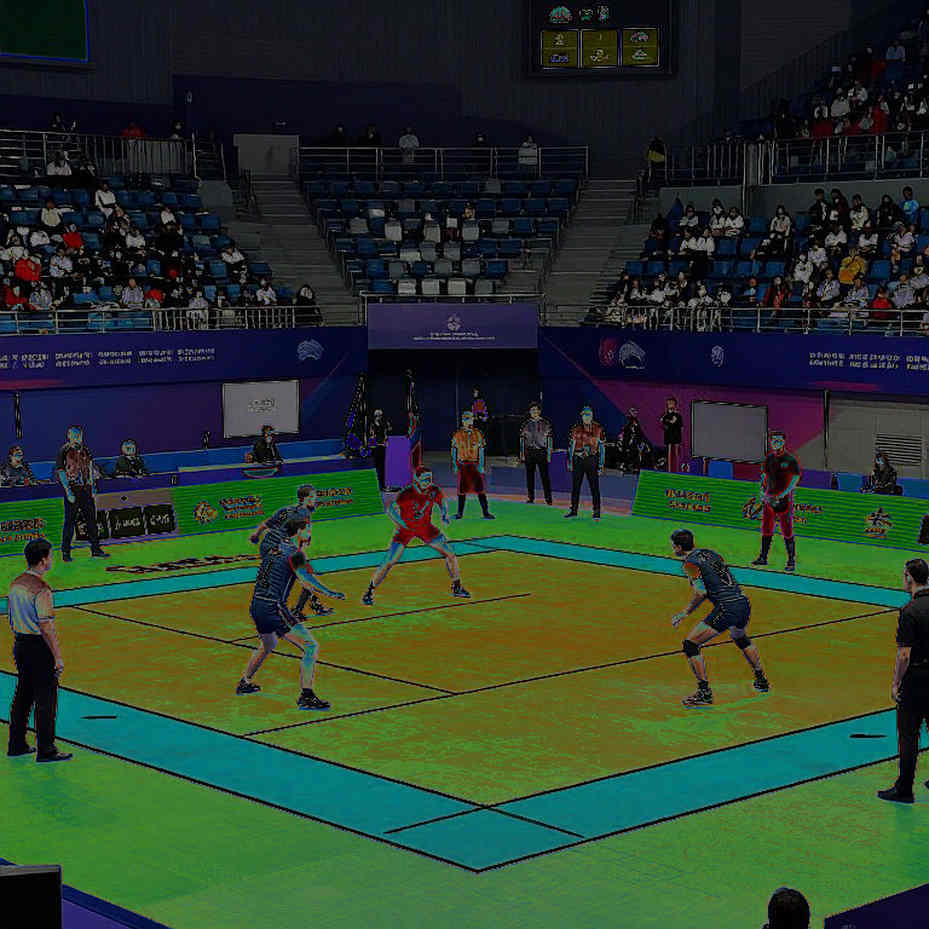
One thing becomes clear here that nobody notices while staring at the standings. If losing by the right margin is a skill in the group stage, that skill is worthless in a knockout. Semi-finals do not calculate point difference. They only have wins and losses. Those who survived here survived on one kind of knowledge; those who went home went home on another kind of ignorance. Which one travels will be answered by the 26th.
Thailand's first medal, and the silent truth of 56 points
Thailand's tournament is history, and there is no shame in admitting it. They secured their first-ever Asian Games kabaddi medal with three wins. But my reporter's instinct cannot step around one number: 83-27. A fifty-six-point defeat to Iran.
Put those two facts side by side and the picture shifts. Thailand's three wins came from the bottom of the table — against Pakistan, Nepal and Malaysia. Against Iran the whole structure collapsed; the gap widened raid after raid, and their covering went empty. Say it without sentiment: Thailand broke a barrier, but the Iran match proved the barrier was a foothill in front of a mountain.
This gap is familiar in international kabaddi. A team first builds confidence beating the weak, then meets the top two and discovers how far behind it is in pace, strength and decision-making. Thailand's real examination is the semi-final, and their opponent there is likely India. You cannot stand in front of a top side with the same method you used to secure a medal against the group's lower half. Where to change has to be decided in the dugout, not on the mat.
Which match killed Pakistan's medal
Let me say this plainly, because the table gives the truth away. Watching Iran beat Pakistan 51-30, you would think Pakistan's campaign died in that night match under the floodlights. The seal was actually stamped days earlier. Five teams in Group B, four matches each. Iran won all four. Thailand won three: against Pakistan, Nepal and Malaysia. Thailand lost to Iran, and they could not have lost to anyone else in that group, since they needed those wins over Nepal and Malaysia. So Pakistan lost to Thailand, beat Nepal and Malaysia, and lost to Iran. Two wins, two defeats.
Iran did not take Pakistan's medal. That medal was lost to Thailand, and the Iran match was only the day the paperwork was stamped. The distinction is not small. A team that points at the final defeat looks for solutions in the wrong room. This is Pakistan's first medal-less return from an Asian Games in kabaddi — source: Khel Now Kabaddi, day-four report of the Asian Games 2026 men's kabaddi group stage. Short as a statistic, loud as a sound in a Pakistani kabaddi household.
And here I want to draw a line. Turning Pakistan's exit into a border-conflict story is easy, and the easy road is not the one this beat should take. The real story is the preparation cycle, the number of camp days, the number of domestic league matches, the continuity of coaching staff. My first calls go to the people nobody asks — the kit man, the physio, the academy boys. For a team returning without a medal, the real loss is not the medal; it is the uncertainty about when the next camp convenes.
India's restraint, and a cold four from four
India won all four, beat Chinese Taipei 37-21, and sealed top spot. In the table's language this is perfection. But anyone who has watched India knows there is a restraint in this four-from-four that the eye tends to miss.
India never chased a fifty-point margin. Against Chinese Taipei, when a hard charge was not needed, they did not charge. India knows when to win by how much, and that self-control is their biggest asset in a semi-final. Teams that empty themselves on every raid in the group stage break down in the knockouts, where four matches in six days demand something physical. And in tournament kabaddi, the body is the real capital.
One thing should be said openly, because nobody discusses it during a tournament. Teams never release the true picture of an injury; the media gets only the word available. Which raider is genuinely at full fitness and who is playing through pain lives inside the dugout, not on paper. So before being satisfied with four from four, ask one question: how much body is actually left. In my experience, sides that find their best rhythm early tend to feel the strain in the second week; finals are decided in the quiet room, not on the mat.
Japan rising, Korea's empty column
Japan deserve a paragraph or the picture of this group stage stays incomplete. They won two matches, finished fourth, and on day four beat Korea 62-35. They did not reach the semi-finals, but their brand of kabaddi caught the tournament's attention.
I remember when the bottom two rows of a kabaddi table were treated as cushions. Now Japan, at home, wrote their name among the teams just outside the top two, and Korea paid the price. Korea lost all four, zero points. Put those two results side by side and Asian kabaddi's geography bears quiet witness to a shift: sides that used to play for fifth are now standing quietly behind second.
I do not want to read this shift only as results. To me it is a story of generational replacement. One Korean generation has stopped; a Japanese generation has grown up over nearly a decade of domestic series. Kabaddi was once a five-minute sport on television here; today leagues, schools and streaming have built a structure. Technology matters in this. Japanese league matches stream on phone screens, and those streams root the sport in young heads. For some teenagers the first kabaddi they ever saw was a live feed on YouTube or Facebook, standing at the doorway of a stream — and even so, that became the platform.
Nepal and Malaysia's evening should not be forgotten either. Nepal finally won on the last day of the league stage, 73-52 over Malaysia, one of the highest-scoring matches of the tournament. Zero to one win, and on the final day: that kind of win cannot be measured in points alone. Malaysia won nothing, but their comeback cycle does not end here; as Asian kabaddi participation grows, consistency will come.

After thirteen years of watching, one belief has hardened in me: the international kabaddi ranking is not a straight line, it is a slow-turning wheel. Today's fifth can be tomorrow's second in ten years — Japan 2026 is that possibility taking its first breath.
The thing everyone is saying, and what the table does not say
Now the thing everyone is saying. The final will be India against Iran, and Thailand and Chinese Taipei are two plates set out to be cooked. The argument is not false: eight matches, eight wins between them, and Iran's 51-point beatings and 83-27 tell you how much they dominate.
Is that the last word? No.
The timeline of knockout kabaddi is compressed compared to the group stage. The do-or-die pressure after regulation time, a raid halting while the referee decides, the holds, the whistles — all of it means those high group-stage scores carry no authority here. 83-27 is a powerful message, but not one of those 56 points can be carried from the table onto the mat in a semi-final. Every raid starts from scratch.
There is another counter-current the table does not spell out. The skill that kept Chinese Taipei alive — controlling the margin of defeat — has no future in a knockout. In a semi-final there is nothing to protect by losing narrowly; a match has to be won. Chinese Taipei will now go to war with a machine built for control, in a setting that has no use for it. For a coaching staff, that is the hardest preparation question there is.
On the other side, Bangladesh's exit is the cruellest arithmetic of the tournament. Two wins, and still the flight home. I do not think Bangladesh had a day where their preparation failed; they lost to the fineness of a table. Missing out on a narrow score difference is like that — the coach's strategy is not guilty, the decimal is.
There is another face to this turn that I am obliged to write about professionally. Chinese Taipei's progression to the semi-finals is a success, no doubt. But if the tournament's structure rewards two wins decided by margin, the coaching logic will tilt defensive rather than attacking. In the next Asian kabaddi cycle many sides will drift toward that protection — and it will slow the game down. A team that stays in the semi-finals stays everywhere, but as a spectator I want to watch the side that is not afraid of risk. That collision sits inside the tournament structure itself.
I can see a resemblance between these 2026 semi-finals and the story of 2026. That year I covered a World Cup from a Lagos viewing centre, and the man in that room was building tables out of point differences. Today it is the same story — the limits of point difference, one careless do-or-die, one match of risk. A table understands through numbers. People understand through memory.
And here kabaddi's cyclical truth returns. In 2026 the lockdown took the games, so I reported the silence between them. The lesson was that a game is not only seven minutes on the mat; it is the wait, the arithmetic, the table reconciled sitting in a courtyard. Day four of the Asian Games 2026 was exactly that picture. Nepal won one match, on the last day — proof that even the bottom row lives by a plan, and a single win is its scraped-together evidence.
Before I left that room in Lagos, the gentleman from Karachi asked me who takes gold on the 26th. I did not answer. On that lagging screen a Chinese Taipei player was smiling, and the Nepalis were clapping at 73-52. The Asian Games 2026 taught us that tournaments are turned by the people who sit below the table and learn to reconcile their own arithmetic.
What to watch
The gold medal match is on September 26, and the real examination comes before it, in the semi-finals. Two of these four sides arrive with unbeaten records; two arrive with their own history. Three things are worth watching.
First, whether Thailand change their raid style after a 56-point defeat to Iran. If they do not, the semi-final may be decided inside the first ten minutes, and the history will remain a flag.
Second, whether Chinese Taipei's control-based structure survives knockout pressure. In a semi-final nobody can play for margin, and Chinese Taipei have no alternative machine.
Third, how much body India and Iran have left on the road to the final. Both won four from four, but one played with restraint and the other with hunger. Who wins the gold will be settled on the mat; before September 26, the question that matters most is this: the teams that won four have four wins in the bag, but a tournament needs one more victory to write history. How much body is left for that one.
I remain the man from the empty terrace. In a game of fourteen, the final calculation is not made by fourteen people, but by the silent accountant in the room. And when the table closes after September 26, the arithmetic will be reconciled by thousands of fans in front of windows and screens. The table has already decided who fights. It has not written who wins — that page is still blank.